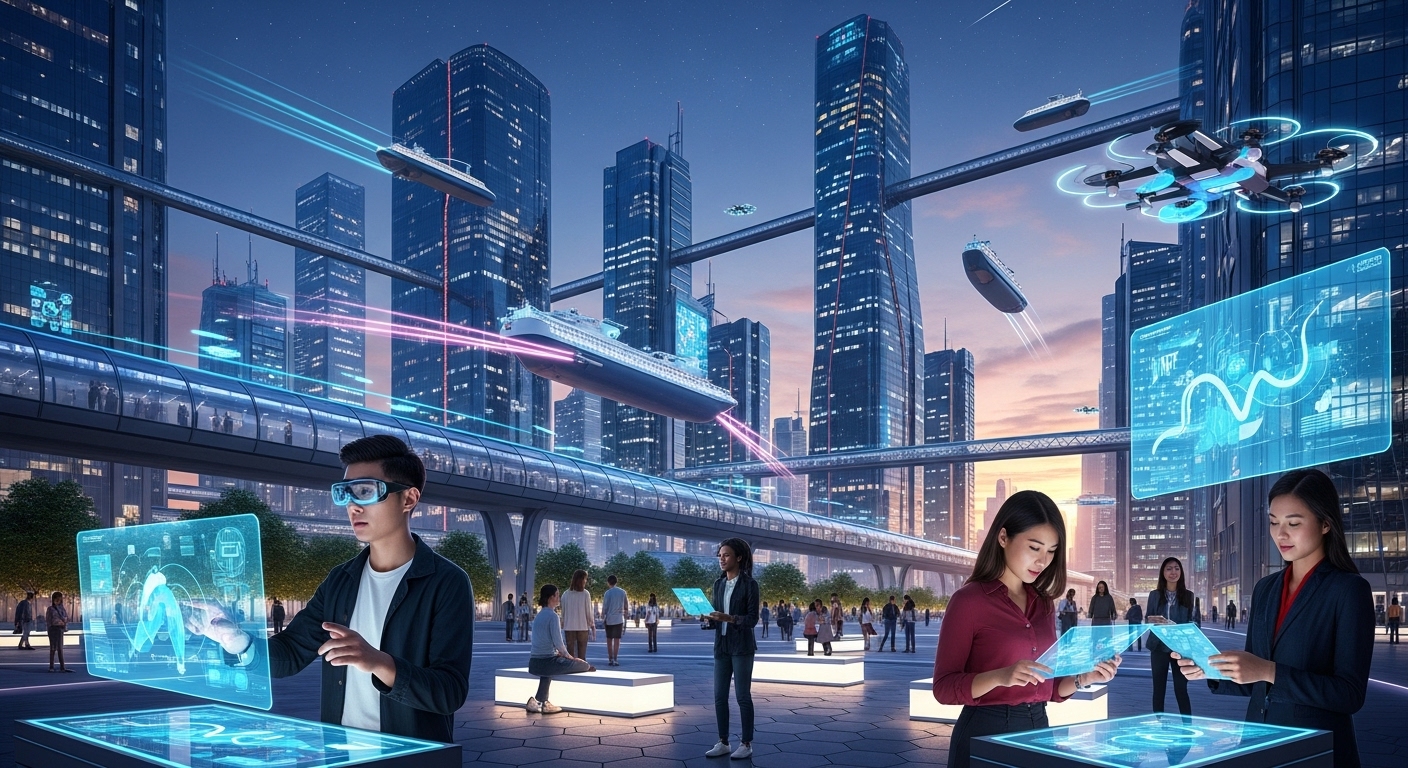

Technology is constantly evolving, reshaping the way we live, work, and interact with the world around us. From the early days of the internet to the rise of artificial intelligence and the advent of quantum computing, the trajectory of technological advancement shows no signs of slowing down. This blog post takes a deep dive into the future of technology, exploring the trends that are set to define the coming decades, the challenges we face in adopting them, and the impact these advancements will have on our daily lives.
1. The Age of Artificial Intelligence
Artificial Intelligence (AI) is no longer a buzzword or a futuristic concept; it’s already transforming industries, improving efficiencies, and augmenting human capabilities. From AI-powered virtual assistants like Siri and Alexa to self-driving cars and predictive analytics, AI is already deeply embedded in our lives. However, what lies ahead is even more remarkable.
In the near future, AI is expected to reach a level of sophistication where machines can make decisions autonomously, learn from experience, and adapt to new situations without human intervention. This could mean a world where AI systems manage everything from healthcare to finance, streamlining operations and making real-time decisions with an unprecedented level of accuracy. For instance, AI-powered diagnostics in healthcare could drastically reduce human error and provide more personalized treatment plans based on a patient’s unique genetic makeup.
2. The Rise of Quantum Computing
Quantum computing has long been an area of research and speculation, but recent developments are bringing us closer to realizing its full potential. Unlike traditional computers that process information in binary (using bits), quantum computers use quantum bits, or qubits, which allow them to perform complex calculations exponentially faster than their classical counterparts.
What does this mean for the future? Quantum computing has the potential to revolutionize fields like cryptography, drug discovery, and even climate modeling. For example, quantum computers could simulate molecular structures to accelerate the development of new medicines, or crack complex encryption codes that are currently unbreakable by today’s systems. Though we’re still in the early stages, the first quantum computers are already being developed, and large-scale implementations could be a decade away.
3. Blockchain Beyond Cryptocurrencies
When most people think of blockchain technology, they immediately associate it with cryptocurrencies like Bitcoin and Ethereum. However, blockchain has far-reaching applications that extend well beyond the realm of digital currencies. At its core, blockchain is a decentralized ledger system that can securely record transactions, ensuring transparency and accountability without the need for a central authority.
In the future, blockchain is expected to play a pivotal role in areas such as supply chain management, voting systems, and even personal data storage. Imagine a world where every step of the journey of a product, from manufacturing to delivery, can be traced on an immutable blockchain, ensuring its authenticity and reducing fraud. Similarly, blockchain could enable more secure and transparent voting systems, reducing the risk of election tampering and fraud.
4. The Expansion of 5G and Beyond
5G technology has been heralded as the next big thing in mobile communications, offering speeds and connectivity that are orders of magnitude faster than current 4G networks. But 5G is not just about faster internet speeds—it’s about enabling a new wave of technological innovations.
With 5G, the world will see the proliferation of the Internet of Things (IoT), where billions of devices will be able to communicate with each other in real-time. This could lead to smarter cities, autonomous vehicles, and more efficient industrial processes. For example, 5G will allow self-driving cars to communicate with each other and with traffic infrastructure, enabling smoother traffic flows and reducing the risk of accidents.
In the long term, the rollout of 5G could pave the way for even faster networks, such as 6G, which will further enhance data transmission speeds and connectivity. This next-generation network will likely be the backbone for many future technologies, including augmented reality (AR) and virtual reality (VR), which will become increasingly immersive and interactive.
5. The Evolution of Augmented and Virtual Reality
Augmented Reality (AR) and Virtual Reality (VR) have come a long way in recent years, and as hardware becomes more powerful and affordable, these technologies are poised to change how we interact with digital environments. While VR immerses users in a completely virtual world, AR overlays digital content onto the physical world, providing new ways to interact with both the real and virtual realms simultaneously.
In the future, AR and VR will likely converge to create Mixed Reality (MR), offering even more immersive experiences. This could revolutionize fields such as education, healthcare, and entertainment. Imagine a classroom where students can explore historical events in 3D or a surgeon performing a complex procedure with real-time AR guidance. In entertainment, AR and VR could bring new forms of interactive storytelling, where users are no longer just passive viewers but active participants in the narrative.
6. The Future of Work: Automation and Remote Collaboration
The future of work is a topic that has gained significant attention, especially in the wake of the COVID-19 pandemic, which accelerated the adoption of remote work technologies. But the impact of technology on the workforce is not limited to where we work—it’s also changing how we work.
Automation is set to take over many repetitive and mundane tasks, freeing up human workers to focus on more complex and creative endeavors. In industries like manufacturing, logistics, and even customer service, robots and AI will handle tasks that were once performed by humans. While this may raise concerns about job displacement, it also presents opportunities for workers to upskill and take on higher-level roles.
At the same time, the future of work will be more collaborative and flexible than ever before. Tools like video conferencing, cloud computing, and collaborative software platforms will enable teams to work seamlessly from anywhere in the world. This shift toward remote and hybrid work environments will likely become permanent, as companies realize the benefits of a distributed workforce, such as reduced overhead costs and access to a global talent pool.
7. The Impact of Technology on Privacy and Security
As technology continues to advance, so too do the concerns around privacy and security. The more interconnected our lives become, the more vulnerable we are to cyberattacks, data breaches, and the misuse of personal information. From social media platforms to smart home devices, the collection and use of personal data have become a central issue in the digital age.
In the future, protecting privacy will require a delicate balance between innovation and security. Advances in encryption technologies, such as quantum encryption, will be critical in safeguarding sensitive information. At the same time, there will likely be increased regulation and oversight of how companies collect, store, and use personal data. Individuals will also become more aware of their digital footprint and take steps to protect their privacy, using tools like VPNs, encrypted messaging apps, and data anonymization services.
8. The Ethical Dilemmas of Technological Advancement
As technology continues to progress at an accelerated pace, it raises a host of ethical questions that society must address. What happens when AI systems make decisions that affect human lives? Who is responsible if a self-driving car crashes? How can we ensure that emerging technologies are developed and used responsibly?
These are just a few of the ethical dilemmas that will need to be carefully considered as we move forward. There will likely be a growing demand for interdisciplinary collaboration between technologists, ethicists, and policymakers to create frameworks for the responsible development and deployment of new technologies. Public discourse around issues like AI ethics, data privacy, and algorithmic bias will be crucial in ensuring that technology benefits society as a whole and does not exacerbate existing inequalities.
9. Sustainability and Green Technology
In the face of climate change and environmental degradation, the tech industry is under increasing pressure to contribute to sustainability efforts. Fortunately, technology has the potential to be part of the solution. From renewable energy solutions like solar and wind power to innovations in energy-efficient computing, the future of tech will likely be intertwined with efforts to reduce humanity’s carbon footprint.
In particular, the rise of green technologies will be a key focus in the coming years. Advances in battery storage, carbon capture, and energy-efficient data centers are just a few examples of how the tech industry is aiming to become more sustainable. Additionally, blockchain technology could be used to track carbon emissions and ensure that sustainability goals are met.
10. Conclusion: Embracing the Digital Future
The future of technology is both exciting and uncertain. While the possibilities are endless, the path forward will require careful consideration of the challenges and risks associated with technological advancement. As we embrace the digital future, it will be essential to prioritize ethical considerations, data privacy, and sustainability, ensuring that these technologies benefit all of humanity.
In the end, technology is not just about gadgets and innovations—it’s about how we use these tools to improve our lives and create a better, more connected world. As we stand on the cusp of this new digital age, the question is not whether technology will continue to change the world, but how we will shape that change.